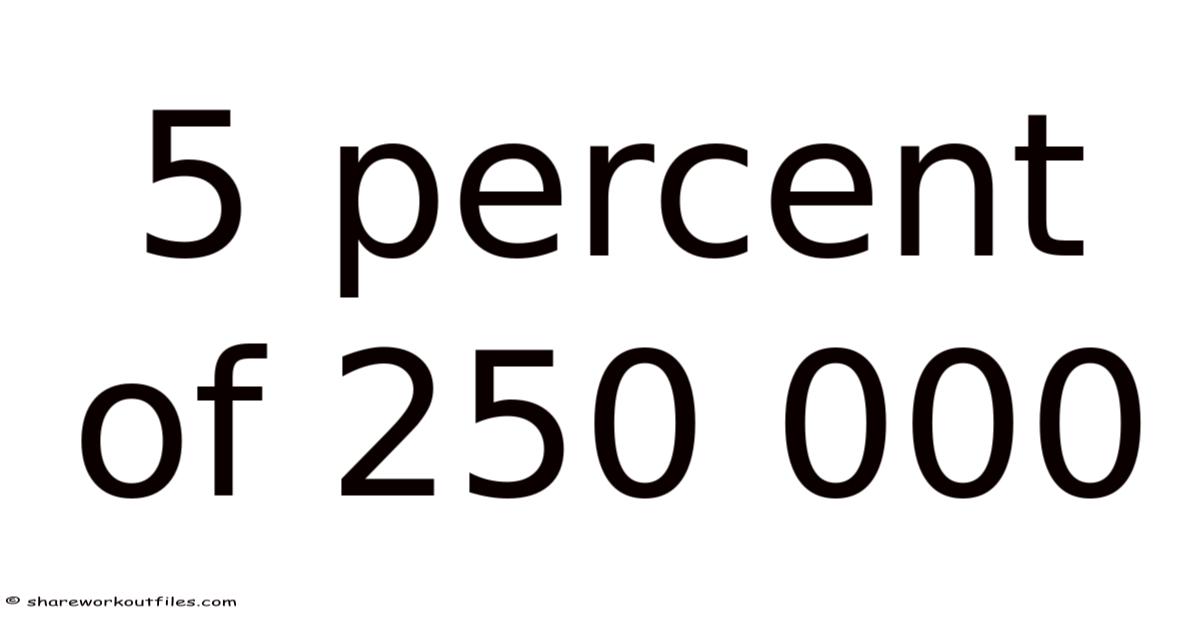
Decoding 5 Percent of 250,000: A full breakdown to Percentages
Calculating percentages is a fundamental skill applicable across numerous fields, from everyday budgeting to complex financial analysis. On the flip side, this article will walk through the calculation of 5 percent of 250,000, providing a step-by-step guide, exploring the underlying mathematical principles, and offering practical applications to solidify your understanding. So understanding how to determine a percentage of a larger number is crucial for making informed decisions and interpreting data effectively. This guide is designed for everyone, from students needing to brush up on their math skills to professionals needing a quick refresher on percentage calculations.
Understanding Percentages: A Quick Refresher
A percentage is simply a fraction expressed as a part of 100. The symbol "%" represents "per cent," meaning "out of one hundred." To give you an idea, 5% means 5 out of 100, which can be written as the fraction 5/100 or the decimal 0.05. This fundamental understanding is key to calculating any percentage of a given number The details matter here..
Calculating 5 Percent of 250,000: The Methods
There are several ways to calculate 5% of 250,000. Let's explore the most common and straightforward methods:
Method 1: Using the Decimal Equivalent
This is arguably the most efficient method. We convert the percentage to its decimal equivalent and multiply it by the number Easy to understand, harder to ignore. But it adds up..
-
Convert the percentage to a decimal: 5% is equal to 5/100 = 0.05.
-
Multiply the decimal by the number: 0.05 * 250,000 = 12,500
Because of this, 5% of 250,000 is 12,500.
Method 2: Using the Fraction Equivalent
This method utilizes the fractional representation of the percentage.
-
Express the percentage as a fraction: 5% is equal to 5/100.
-
Multiply the fraction by the number: (5/100) * 250,000 = 1,250,000 / 100 = 12,500
Again, we arrive at the answer: 5% of 250,000 is 12,500.
Method 3: Finding 1% and Scaling Up
This method is particularly useful for mental calculations or when dealing with less straightforward percentages.
-
Find 1% of the number: 1% of 250,000 is 250,000 / 100 = 2,500
-
Multiply the 1% value by the desired percentage: 2,500 * 5 = 12,500
This confirms that 5% of 250,000 is 12,500 Which is the point..
Practical Applications and Real-World Scenarios
Understanding percentage calculations is vital in various real-world contexts. Here are a few examples illustrating the relevance of calculating 5% of 250,000:
-
Sales Commissions: Imagine a salesperson whose commission is 5% of their total sales. If their total sales for the year reach 250,000, their commission would be 12,500.
-
Tax Calculations: A 5% sales tax on a 250,000 purchase would amount to 12,500 Easy to understand, harder to ignore..
-
Investment Returns: If an investment of 250,000 yields a 5% return, the profit would be 12,500 Easy to understand, harder to ignore..
-
Discount Calculations: A 5% discount on a 250,000 item would reduce the price by 12,500.
-
Population Statistics: If a city's population of 250,000 experiences a 5% increase, the increase would represent 12,500 individuals.
Beyond the Basics: Extending Percentage Calculations
While calculating 5% of 250,000 is straightforward, mastering percentage calculations involves understanding how to tackle more complex scenarios:
-
Calculating Percentage Increase/Decrease: These calculations often involve finding the difference between two values and expressing it as a percentage of the original value. As an example, if the population increases from 250,000 to 262,500, the percentage increase is [(262,500 - 250,000) / 250,000] * 100% = 5% And it works..
-
Finding the Original Value: If you know the percentage and the resulting value, you can work backward to find the original value. Here's one way to look at it: if 5% of a number is 12,500, the original number is 12,500 / 0.05 = 250,000.
-
Compounding Percentages: This involves calculating percentages over multiple periods, where the interest or growth is added to the principal amount before calculating the next period's percentage. To give you an idea, calculating the value of an investment after 5 years with a 5% annual compound interest would require a more complex calculation involving exponential growth.
-
Dealing with Percentages of Percentages: These scenarios often arise in situations involving discounts or taxes on already discounted items. Here's one way to look at it: a 10% discount followed by a further 5% discount is not equivalent to a 15% discount Nothing fancy..
Mathematical Principles at Play
At the heart of percentage calculations is the concept of proportion. A percentage represents a proportional relationship between a part and a whole. The formula for calculating a percentage of a number can be expressed as:
(Percentage/100) * Number = Result
This fundamental formula underlies all the methods discussed above. Understanding this formula empowers you to solve a wide range of percentage problems.
Frequently Asked Questions (FAQ)
-
Q: How do I calculate a different percentage of 250,000?
A: Simply replace the 5% with your desired percentage and follow any of the methods described above. Remember to convert the percentage to a decimal or fraction before multiplying by 250,000.
-
Q: What if the percentage involves decimals, such as 5.5%?
A: Follow the same procedures, converting 5.5% to its decimal equivalent (0.055) and multiplying by 250,000. This would yield 13,750 Small thing, real impact..
-
Q: Are there any online calculators to verify my calculations?
A: Yes, many online percentage calculators are readily available. Using these can be a helpful way to double-check your work.
Conclusion
Calculating 5% of 250,000, resulting in 12,500, is a straightforward yet fundamental skill. While this article focused on a specific example, the principles and methods discussed apply broadly, allowing you to confidently tackle a wider range of percentage problems. Practically speaking, remember, practice is key to mastering this important skill. In real terms, from everyday budgeting to complex financial analysis, mastering percentage calculations is key to making informed decisions and interpreting data accurately. Understanding the underlying principles of percentages and the various methods for calculating them equips you with a valuable tool applicable in numerous scenarios. By practicing different methods and tackling various scenarios, you'll build your confidence and proficiency in working with percentages.
