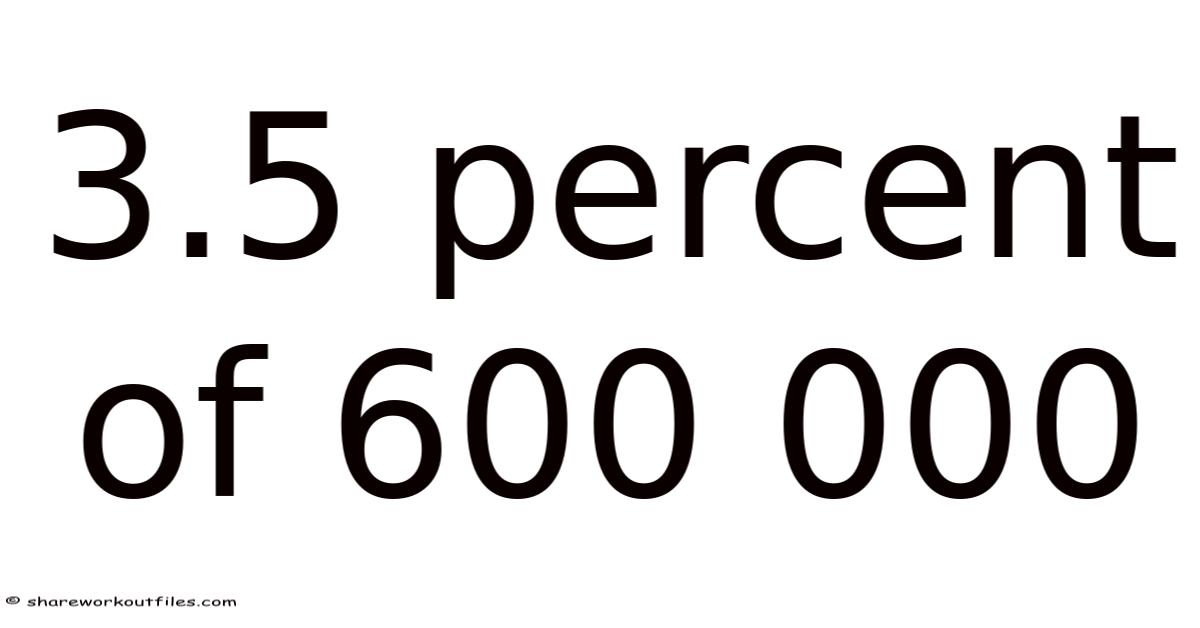
Decoding 3.5 Percent of 600,000: A full breakdown to Percentage Calculations
Finding 3.5 percent of 600,000 might seem like a simple arithmetic problem, but understanding the underlying principles is crucial for various applications, from everyday budgeting and financial planning to advanced statistical analysis. This full breakdown will not only provide the solution but also walk through the methodology, explore different calculation approaches, and offer practical examples to solidify your understanding of percentages. This article will equip you with the skills to confidently tackle similar percentage calculations in various contexts.
Understanding Percentages: The Foundation
Before diving into the calculation, let's solidify our understanding of percentages. That's why the symbol "%" represents "per hundred" or "out of 100. " To give you an idea, 50% means 50 out of 100, which is equivalent to ½ or 0.A percentage is simply a fraction expressed as a part of 100. 5 in decimal form. Understanding this fundamental concept is key to mastering percentage calculations Simple, but easy to overlook..
Method 1: The Decimal Approach
This is arguably the most straightforward method for calculating percentages. It involves converting the percentage to a decimal and then multiplying it by the total value.
Steps:
-
Convert the percentage to a decimal: To convert 3.5% to a decimal, divide it by 100: 3.5 / 100 = 0.035
-
Multiply the decimal by the total value: Multiply the decimal (0.035) by 600,000: 0.035 x 600,000 = 21,000
So, 3.5% of 600,000 is 21,000.
Method 2: The Fraction Approach
This method involves converting the percentage to a fraction and then multiplying it by the total value. This method is particularly useful when dealing with percentages that are easily expressed as simple fractions.
Steps:
-
Convert the percentage to a fraction: 3.5% can be written as 3.5/100. To simplify this fraction, we can multiply both the numerator and the denominator by 10 to remove the decimal: (3.5 x 10) / (100 x 10) = 35/1000. This fraction can be further simplified by dividing both numerator and denominator by 5: 7/200
-
Multiply the fraction by the total value: Multiply the fraction (7/200) by 600,000: (7/200) x 600,000 = 7 x 3000 = 21,000
Again, we arrive at the answer: 3.5% of 600,000 is 21,000.
Method 3: Using Proportions
This method is a more algebraic approach that is helpful in understanding the relationship between the percentage, the part, and the whole. We can set up a proportion to solve for the unknown part.
Steps:
-
Set up the proportion: We can represent the problem as a proportion: x / 600,000 = 3.5 / 100
-
Cross-multiply: Cross-multiply to solve for x: 100x = 3.5 x 600,000
-
Solve for x: 100x = 2,100,000 => x = 2,100,000 / 100 => x = 21,000
Once again, we confirm that 3.5% of 600,000 is 21,000 Small thing, real impact..
Practical Applications and Real-World Examples
Understanding percentage calculations has far-reaching applications in various fields. Here are a few examples:
-
Finance: Calculating interest on loans, savings accounts, or investments. To give you an idea, if you have $600,000 in an investment account that earns 3.5% annual interest, you would earn $21,000 in interest after one year Easy to understand, harder to ignore..
-
Sales and Discounts: Determining the discount amount on sale items. If a $600,000 property is discounted by 3.5%, the discount amount would be $21,000.
-
Statistics and Data Analysis: Calculating percentages in surveys, polls, or research studies. Take this: if 3.5% of 600,000 respondents answered “yes” to a specific question, that represents 21,000 respondents.
-
Tax Calculations: Determining the amount of tax payable on income or property. If the tax rate is 3.5% on a $600,000 property, the tax payable would be $21,000.
Beyond the Basics: Dealing with More Complex Percentages
While the above methods effectively handle straightforward percentage calculations, let's explore how to deal with more complex scenarios:
-
Calculating Multiple Percentages: Suppose you need to calculate 3.5% and then add another percentage to the result. You would calculate 3.5% first and then apply the second percentage to the new total.
-
Calculating Percentages of Percentages: This involves finding a percentage of a percentage, which requires a two-step calculation. To give you an idea, finding 2% of 3.5% of 600,000 first involves calculating 3.5% of 600,000 (21,000) and then finding 2% of 21,000 (420) Small thing, real impact..
-
Working with Decimals in Percentages: When dealing with percentages that are not whole numbers (like 3.5%), it's crucial to maintain accuracy throughout the calculation. It's often helpful to use a calculator to avoid rounding errors.
-
Dealing with Large Numbers: When working with very large numbers like 600,000, using a calculator or spreadsheet software can significantly simplify the calculations and minimize the risk of errors.
Troubleshooting and Common Errors
-
Incorrect Decimal Conversion: The most frequent error is converting the percentage to a decimal incorrectly. Always remember to divide the percentage by 100.
-
Mathematical Errors: Double-check your calculations to avoid simple mathematical errors, especially when working with large numbers Most people skip this — try not to. No workaround needed..
-
Rounding Errors: When rounding numbers during intermediate steps, rounding errors can accumulate and affect the final result. It is best practice to wait until the end of a calculation before rounding to avoid compounding rounding errors.
Frequently Asked Questions (FAQ)
-
Q: How can I calculate percentages quickly without a calculator? A: For simpler percentages, you can use mental math techniques or estimations. As an example, 10% of 600,000 is 60,000, so 5% would be half of that (30,000), and 3.5% would be a bit less than that. Still, for accurate results, a calculator is always recommended That's the whole idea..
-
Q: What if the percentage involves a fraction, like 3 1/2%? A: Convert the mixed number to a decimal first (3.5). Then, proceed using the methods described earlier.
-
Q: Can I use a spreadsheet program like Microsoft Excel or Google Sheets to calculate percentages? A: Yes, spreadsheets offer powerful functions to perform percentage calculations easily and efficiently. You can simply use the formula
=0.035*600000in a cell to directly calculate the result Most people skip this — try not to..
Conclusion: Mastering Percentage Calculations
Understanding how to calculate percentages, particularly as applied to larger numbers like 600,000, is a valuable skill with broad applications. While finding 3.Which means 5% of 600,000 might seem straightforward, grasping the underlying principles and the various calculation methods empowers you to confidently tackle a wider range of percentage problems. This knowledge will be invaluable in various aspects of your personal and professional life, allowing you to make informed decisions, analyze data effectively, and solve problems more efficiently. Remember to choose the method you find most comfortable and always double-check your work to ensure accuracy And that's really what it comes down to..
